Every Pay System Creates Incentives
Flat rate has existed in the automotive industry for decades. Supporters argue it rewards productive technicians, encourages efficiency, and gives experienced mechanics the opportunity to earn more than an hourly wage. There is truth in that. Many talented technicians have built successful careers under flat rate. But every compensation system creates incentives. And every compensation system determines one very important thing. Who carries the financial risk when something goes wrong?
Follow The Money
Every business has financial goals. Manufacturers answer to shareholders. Dealerships answer to owners. Managers answer to performance metrics. None of that is surprising. Businesses exist to make money. Manufacturers work hard to keep warranty costs predictable. Dealerships work hard to improve productivity. Service managers work hard to move more vehicles through the shop. Every level of the industry has incentives that encourage efficiency and profitability. There is nothing controversial about that.
The more interesting question is what happens when those financial goals collide with the technician performing the repair.
Somebody Always Carries The Risk
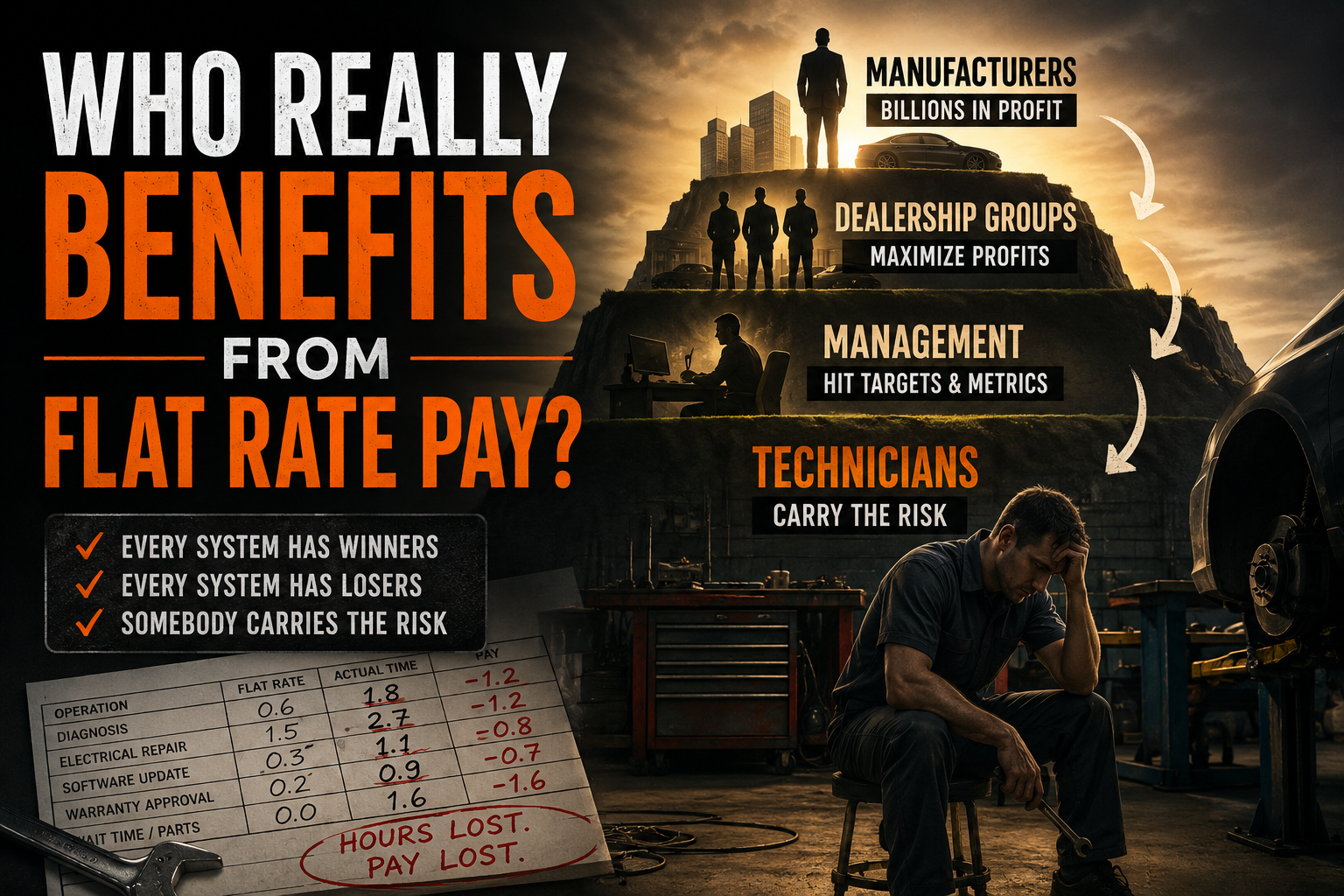
Modern vehicles are more complicated than ever. Technicians spend time diagnosing electrical problems, performing software updates, documenting repairs, waiting for warranty approvals, tracking down parts, and completing procedures that simply didn't exist twenty years ago. Many of those delays are outside the technician's control. Yet someone still absorbs the financial impact.
When a repair takes longer because of backordered parts... When factory authorization is delayed... When software refuses to cooperate... When labor times fail to reflect reality... Who loses income?
- The manufacturer?
- The dealership?
- The technician?
In many cases, the technician is the one whose paycheck changes.
Flat Rate Doesn't Eliminate Risk
One of the strongest arguments in favor of flat rate is that it rewards efficiency. And it often does. But flat rate also shifts financial risk. Unexpected complications rarely reduce the manufacturer's costs. They don't usually change shareholder expectations. Management salaries generally remain the same. The technician, however, often feels the impact immediately. A repair that should have been profitable can become a losing job through no fault of the person performing the work.
The Hill
Imagine the automotive industry as a hill. At the top are billion-dollar manufacturers. Below them are dealership groups. Below them are service managers trying to satisfy customers, manufacturers, and ownership at the same time. At the bottom are the technicians who physically repair the vehicles. Every decision made higher on the hill eventually rolls downhill. The technician is often expected to absorb delays created by engineering decisions, warranty procedures, software problems, supply chain issues, and labor operations that may no longer reflect the complexity of today's vehicles.
The Bigger Question
This article isn't arguing that manufacturers shouldn't make profits. Nor is it suggesting dealerships shouldn't operate efficiently. Healthy businesses are important for everyone in the industry. The question is much simpler. Has the automotive industry reached a point where technicians are carrying more financial risk than anyone else involved in the repair process? If the answer is yes, should the compensation system evolve to reflect the realities of modern vehicles?
Final Thoughts
Flat rate has created successful careers for thousands of technicians. It has also created frustration for many others. Perhaps the debate isn't whether flat rate is good or bad. Perhaps the better question is whether the financial risk is being shared fairly. Because every repair order has a winner and a loser. The question is... Who was the system designed to protect?